

The History Column: Alan Blumlein

Alan Dower Blumlein was a brilliant and prolific British electronic engineer. He was born in Hampstead, London, in 1903, and was educated at Highgate School and the City & Guilds College (part of Imperial College).

Alan Blumlein (EMI Archive Trust).
He worked for the Standard Telephones and Cables (STC) company, then for the Columbia Gramophone Company, which in 1931 became Electric and Musical Industries Ltd (EMI). He had no fewer than 128 patents to his name, several of which have been very significant. These include:
• A moving-coil disc cutting head, which circumvented a Bell patent and gave greatly-improved sound quality
• An ultra-linear amplifier design
• An improved form of AC measurement bridge which became known as the Blumlein Bridge
• The cathode follower circuit, providing unity-gain, high input impedance and low output impedance
• The long-tailed pair differential amplifier, now universally used in operational amplifier integrated circuits
• Stereo sound (recognised as an IEEE Historic Milestone, at the Abbey Road recording studios in London in 2015)
• The 405-line television modulation format
• The slot antenna – essentially the electromagnetic dual of the dipole
• The transversal filter
A full list and explanation of Blumlein’s patents is given in Russell Burns’ excellent book on Blumlein, cited at the end of this article.
During WW2 he worked on airborne radar, and in particular on the development of Airborne Intercept Radar (AI), and H2S, which was carried by bomber aircraft and used for navigation and for precision bombing, especially in conditions of poor visibility. This used a cavity magnetron, and the S-band microwave frequency meant that it was possible to obtain high directivity and gain, and hence a map-like display, from a scanning antenna mounted underneath the aircraft. Blumlein made many contributions to the design of H2S, including the line type pulse modulator.
The sketch below was drawn by Blumlein and sent to his young sons Simon and David. It shows him in a trials aircraft flying off the south coast of England.
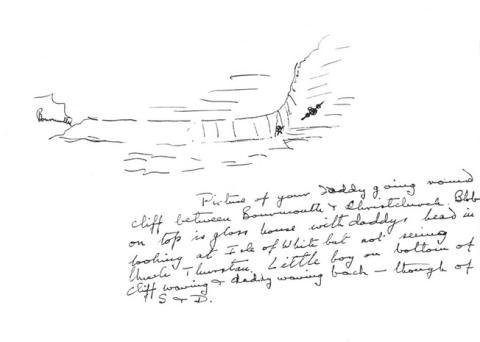
Sketch by Blumlein sent to his sons Simon and David.
The caption reads:
Picture of your Daddy going round cliff between Bournemouth & Christchurch. Blob on top is glass house with daddy’s head in looking at Isle of White [Wight] but not seeing Uncle Thurstan. Little boy on bottom of cliff waving and daddy waving back – thought of S & D.
On 7 June 1942 a Handley Page Halifax trials aircraft carrying a crew of 11 including Blumlein and two other EMI scientists, Cecil Oswald Browne and Frank Blythen, took off from RAF Defford. The aircraft developed a fire in one of its engines, and it crashed near the village of Welsh Bicknor in Herefordshire, killing all on board. A team led by Bernard Lovell was despatched immediately to the crash site to retrieve the highly secret cavity magnetron in the H2S radar.
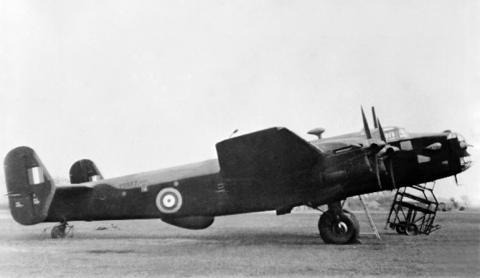
The Handley Page Halifax aircraft in which Blumlein was killed when it crashed. The radome carrying the H2S radar can be seen under the belly of the aircraft (public domain).
Blumlein’s personality was described as quiet, modest, with a remarkable memory. He was fond of practical jokes, and sometimes forgetful. One of his colleagues, P.B. Vanderlyn, said of him:
Blumlein professionally had two cardinal virtues: he would keep in daily touch with all of the work in the laboratories, and he would talk with the most junior of us as equals without ever making us conscious of our lack of status, which was good for our egos and even better for our technical education.
Blumlein’s son Simon ran a record shop in Petersfield, Hampshire for many years, with the slogan: ‘Blumlein – the first name in stereo’. He gave lectures on his father’s life and work, and was a strong supporter of the Defence Electronics History Society (DEHS) in the UK.
Alan Blumlein died at the tragically young age of 38. One can only imagine what more he would have achieved if he had lived longer.
Acknowledgement: I am grateful to Simon Watts for his helpful comments on an early draft.
Further information may be found in:
- Burns, R.W., The Life and Times of A.D. Blumlein, IEE History and Management of Technology Series, 2000.
- Alexander, Robert, The Inventor of Stereo: The Life and Works of Alan Dower Blumlein, Focal Press, 1999.
- https://ethw.org/Milestones:Invention_of_Stereo_Sound_Reproduction,_1931
Written by Hugh Griffiths
University College London