

The History Column: Lord Lovat’s Piper

Bill Millin was a Scottish soldier serving as the personal piper to Simon Fraser, 15th Lord Lovat, the commander of the British 1st Special Service Brigade going ashore in Normandy, in the D-Day landings on the 6th June, 1944. Lovatt ordered Millin to play his pipes on the beach to encourage the soldiers advancing under heavy German fire. Remarkably, Millin was untouched, despite marching up and down the beach, playing regimental tunes, strongly motivating the soldiers charging up the beach.
On being commanded to play, Millin pointed out that the British Army had forbidden piping on the front. Lovatt, however, told him this was an English Army rule and did not apply to a Scottish Regiment. In the First World War, more than a thousand pipers lost their lives leading troops into battle. German snipers interviewed after the D-Day assault said they did not target Millin as they thought he had ‘lost it’. He would not have known that, and danger of stray bullets was very real. A brave man.
Marching, balancing and blowing the pipe, playing a tune simultaneously, can only be done upright on a reasonably flat surface. A piper cannot lead a charge, but provides motivation to his comrades.
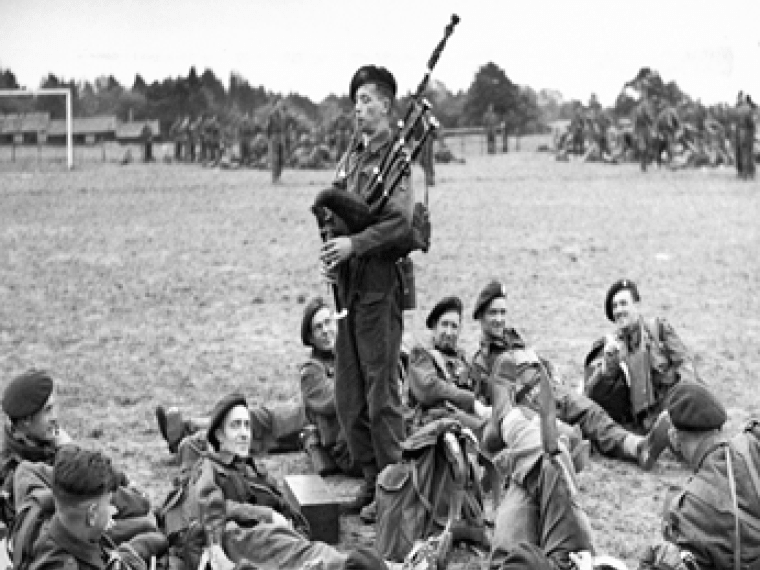
Millin playing his pipe to members of his regiment in 1944 (Evans, J L (Capt), public domain).
Millin survived the war, and died on 18 August 2010. There is a statue of him at Sword Beach, Normandy.
Let us have a look at the importance of the piper to a Scottish soldier, and to the pipe itself.
The sound of the Greater Highland Bagpipe (GHB) inspires largely binary responses from people: either love or hatred! Apparently pipers walk when playing as a moving target is more difficult to hit! The chanter reed output is estimated at 300 mW, with an envelope rich in harmonics that travels far. Folk tunes that have become part of a regiment’s culture are played, inspiring soldiers and projecting the presence of the regiment. Millin, once on the beach, played these regimental tunes. Pipe tunes and songs are very much part of the culture and identity of a Scottish Regiment. Regiments were recruited in districts of the Highlands of Scotland, so there was a strong cultural bond in music and dancing. Highland Regiments have dancers that perform sword dances.
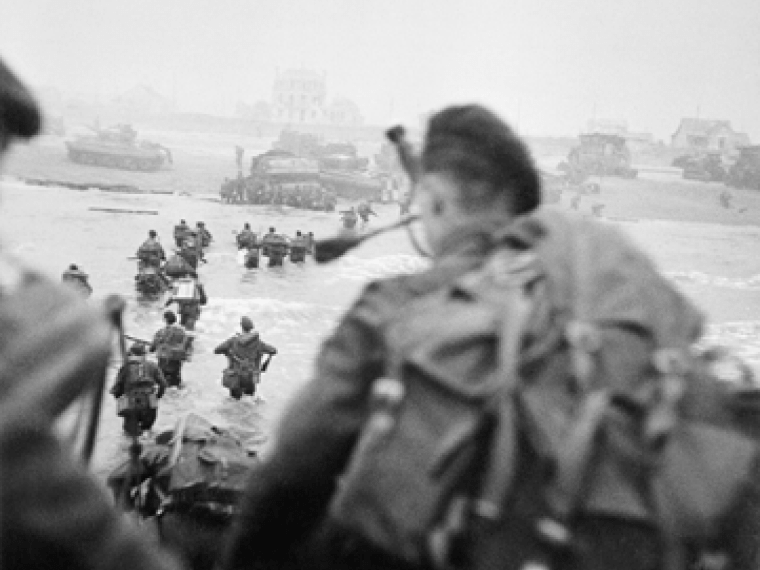
Millin about to wade ashore on 6 June, 1944. He is in the right foreground, his bass drone and cord just visible. Lord Lovatt is to the right of the wading column, centre, left. (Evans, J L (Capt), public domain).
The Greater Highland Bagpipe was, according to the Irish, given to their Scottish cousins as a joke which the dour Scots have never quite understood. More seriously, the bagpipe is common in Western Europe, in various forms i.e. an air reservoir feeding a tube with holes where a melody is played. The reservoir is either fed with a bellows or by direct blowing, as is the case for the GHB.
The structure of the pipe and its music was strongly influenced by the personal pipers of the Scottish chieftains, especially the school on the Isle of Skye set up by the MacLeods, dating back to the 1400s.
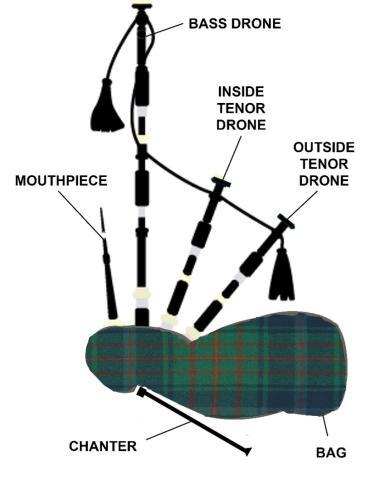
The Greater Highland Bagpipe
The piper tucks the bag under the left arm, the drones resting on the shoulder. Air is blown into the blowpipe that is fitted with a non return valve. The three drones (two at the same pitch as the chanter, one an octave lower) sound continuously. Between breaths the piper squeezes the bag with the arm, to keep the pitch of the drones and chanter constant. Only good pipers achieve this perfect balance.
The chanter has 8 holes. When all are closed, a 9th note is possible. The intervals are pentatonic, in common with most folk music. Since the notes sound continuously, to repeat the same note, short notes (grace notes) either higher or lower than the playing note are sounded, often in groups, known as ‘doublings’. These transitions have evolved into intricate patterns, testing the skill even of a good piper.
Technology has improved the maintenance of the GHB. Instead of belly leather from a cow or sheep, the bag can be made of a breathable fabric, such as Goretex™. Drone reeds have plastic bodies, with carbon fibre tongues. The chanter reed has remained cane (from Spain) and the drones, African Blackwood. Many chanters are now ABS plastic, also wood is favoured by some. There is even a revival of drones back to a tube segment of cane, with cuts to free up a tongue to vibrate.
Further information may be found at:
- https://warfarehistorynetwork.com/article/the-story-of-bill-millin-lord…
- https://www.facebook.com/BritishMemorial/videos/d-day-80-piper-bill-mil…
Written by Michael Inggs
University of Cape Town
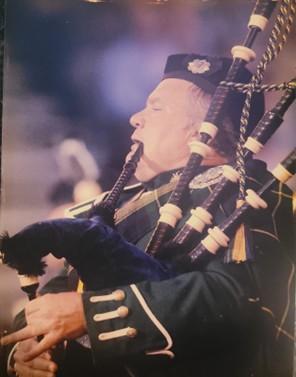
Professor Mike Inggs was an outstanding radar engineer and a prominent member of the international radar community. He spent the bulk of his career at the University of Cape Town in South Africa. He was also an accomplished piper, and he wrote this History Column as a guest contribution, shortly before he passed, in April 2025. The picture above shows him in the uniform of the Cape Town Highlanders, playing at the Edinburgh Tattoo.