

The History Column: The Seetakt Radar on the Admiral Graf Spee

The Admiral Graf Spee was a German Heavy Cruiser (sometimes known as a Pocket Battleship) which took part in the Battle of the River Plate on 13 December 1939. This was the first proper naval engagement of WW2. Graf Spee was a formidable warship, described as ‘faster than anything bigger, and bigger than anything faster’. She displaced 16,000 tons at full load, was 186 m long, and carried six 11-inch guns in two triple turrets. She had diesel engines rather than the more usual steam turbines, and had a top speed of 28 knots. Her commander was Kapitän-zur-See Hans Langsdorff.
She was the first German warship to carry a radar – a FuMG 38G Seetakt operating at 500 MHz, built by the GEMA company, with a maximum range of about 8 nautical miles (15 km). The radar was used for target detection and fire control, especially in conditions of poor visibility.
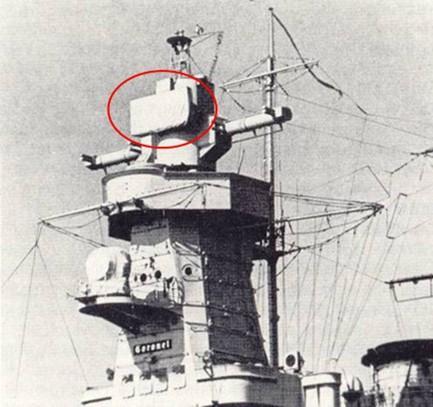
Graf Spee had been engaged in interception and sinking of merchant shipping in the South Atlantic. She was intercepted by a squadron of three cruisers (HMS Exeter, HMS Ajax and HMNZS Achilles) commanded by Commodore Henry Harwood. Although the three cruisers were outgunned by Graf Spee, they attacked immediately. All three of the cruisers sustained damage – particularly Exeter, which had to withdraw to the Falklands for repair. But Graf Spee, too, suffered significant damage, with 36 of her crew killed and 60 wounded. She took refuge in the neutral port of Montevideo (Uruguay). Her captain determined that the damage to Graf Spee and her supply of ammunition were such that she could not risk further combat, so he scuttled her with explosive charges just outside Montevideo, and then three days later he committed suicide. The story is told in Powell and Pressburger’s excellent movie The Battle of the River Plate (1956), which may easily be found online.
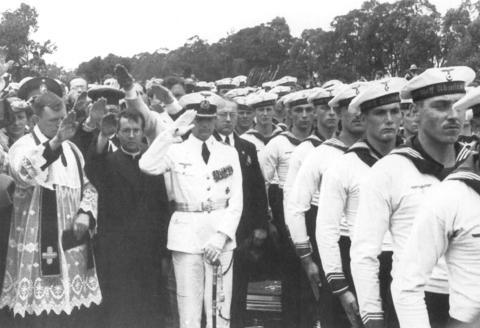
The picture below shows Langsdorff at the funeral of his crewmembers killed in the battle. Note that he gives the naval salute rather than the Nazi salute. Peter Gregory reports that his father was an Electrical Artificer on HMS Ajax, and that some of the crew asked to attend the funeral. The request was turned down, but it did show that there was a certain camaraderie and respect between sailors whichever side they were on.
It is not clear whether the radar played any significant part in the battle. One source suggests that vibrations from the guns or from the diesel engines may have caused the copper cables to the radar antenna to fail.
The British Minister to Uruguay, Eugen Millington-Drake, noticed the Seetakt radar on Graf Spee when she entered Montevideo, and understood its significance. After the scuttling, part of the wreck, including the radar, was still visible. Millington-Drake was acquainted with a Uruguayan businessman and persuaded him to buy the salvage rights to the wreck for £14,000. A British scientific intelligence expert, Labouchère Hillyer Bainbridge-Bell, was sent to Montevideo, posing as a scrap metal dealer, to inspect the radar and to bring parts of it back to the UK for detailed analysis. This he was able to do, and the pictures below show his sketch of the radar, and part of the radar display, which was until recently on display at the museum at the British naval base HMS Collingwood. This provided invaluable and unique intelligence on German radar capability and development at that time.
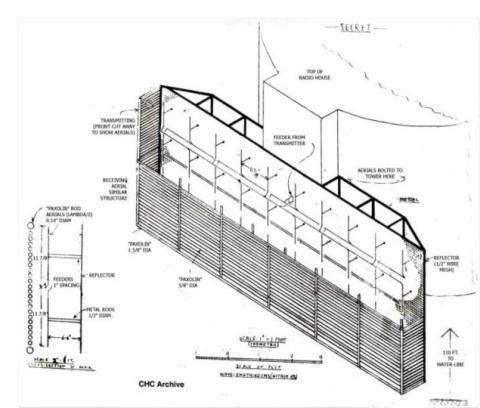
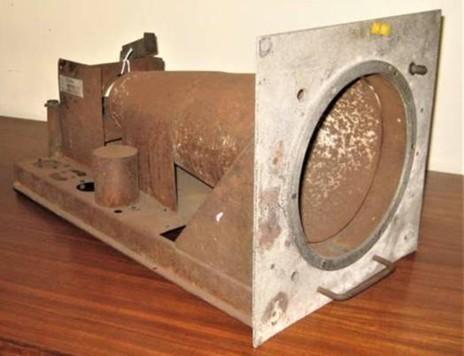
Acknowledgement: the photo and sketch of the radar are from Clive Kidd, formerly Hon. Curator of the HMS Collingwood Heritage Collection. Articles from the Heritage Collection are now in the hands of the National Museum of the Royal Navy ((Click to show email)).
Further information may be found in:
- Dudley Pope, The Battle of the River Plate, W. Kimber, 1956.
- Sir Eugen Millington-Drake, The Drama of Graf Spee and the Battle of the River Plate, Peter Davies, 1964.
Authored by Hugh Griffiths
University College London