

Story Behind the Success: Rong Yang

I am truly honored to receive the 2025 IEEE AESS Early Career Award. I also want to take this moment to acknowledge the Institute of Navigation, which recently recognized me with the Per Enge Early Achievement Award. Both of these honors mean a great deal to me, and I am deeply grateful for the encouragement they represent. For me, this feels less like a finish line and more like a quiet reminder to keep going.
My story started in a different place. During my PhD at NTU in Singapore, I was fully absorbed in high-sensitivity and high-dynamic tracking algorithms for GNSS receivers. It was a deeply technical world. Then Professor Jade Morton visited our lab. That visit changed everything. She introduced me to GNSS remote sensing. It was the idea that the signals I had been tracking so carefully could actually be used to look back at the Earth and study its atmosphere. That moment planted a seed. My curiosity about the ionosphere started to grow.
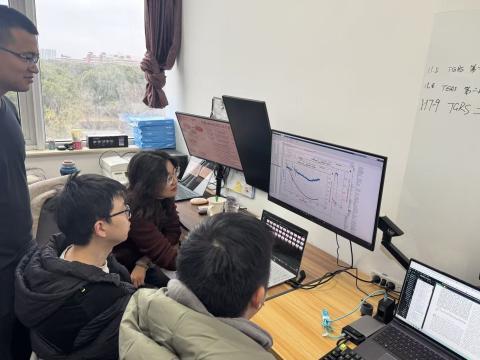
After my PhD, I was very fortunate to join Professor Morton's group in the United States as a postdoc. There, I used my tracking algorithms to study ionospheric and tropospheric scintillation. A key insight came during those years: scintillation affects GNSS signals differently at different frequency bands. This frequency-dependent behavior really interested me. It was not just noise. It was a signature of something deeper. I began building a theoretical framework for multi-frequency joint tracking. The algorithms that came from this work turned out to be very effective at reducing scintillation effects. That work did more than just help with space weather. It planted a second, deeper seed. Without knowing it at the time, the multi-frequency approach and the physics of signal scattering in the ionosphere were quietly getting me ready for a much more down-to-earth challenge. They were shaping my understanding of what it really means to make GNSS resilient in challenging environments.
Then I returned to China and joined the School of Aeronautics and Astronautics at Shanghai Jiao Tong University (SJTU) in 2019. Once again, I was met with generosity and trust. I joined the navigation, guidance and control (GNC) group led by Professor Xingqun Zhan. The school and my team gave me strong support. Professor Zhan offered me a rare gift: the freedom to follow the research I truly believed in. He always reminded me to focus on the real science, stay away from distractions, and just concentrate on meaningful work. That trust gave me the courage to change direction. I had originally planned to keep working on the ionosphere. But Shanghai's ionosphere is relatively quiet, and strong scintillation events are rare. With my group's support, I felt safe enough to ask: where else could this knowledge be useful? The answer was right in front of me, in the dense urban canyons of the megacity I now called home. I realized that the challenging environment I wanted to tackle had simply shifted from the upper atmosphere to the streets around me.
Urban multipath has always been a tough, stubborn problem for the GNSS community. It is one of the biggest threats to resilient positioning in cities. As I looked deeper, something clicked. The way buildings reflect and scatter signals is physically similar to how ionospheric irregularities distort radio waves. Both lead to complex distortions across time, space, and frequency. The multi-frequency approach I had developed for scintillation suddenly found a new purpose. I started to move those ideas into a unified time-space-frequency framework. The goal was not just to suppress multipath, but to use it as a new dimension of signal diversity. In the end, the research recognized by this award, the work on resilient PNT and enhanced GNSS performance in challenging environments, grew directly from the seeds planted during my time with Jade Morton. It was able to bloom because of the supportive environment created by my school, my GNC team, and Professor Zhan's constant encouragement.
Of course, the road from that idea to real theory was never straight. When I first began working on urban multipath, I was full of self-doubt. So many smart researchers had already worked on this problem. What could I possibly add? Some nights I simply didn't want to think anymore. In the end, I stopped waiting for the perfect idea and just jumped in. I told myself, "Stop overthinking, just push forward." What helped me change was learning to value "wrong" results. Earlier, I was afraid of failed experiments. Now I truly treasure them. If you only look for clean, positive outcomes, you miss clues hidden in the noise. I often tell my students: if there are ten possible paths and you have tried nine that are wrong, then the last one must be right. The key is to have the strength to keep going. That strength was deeply nurtured by the supportive scientific family I found, both with Jade and with my group in Shanghai.
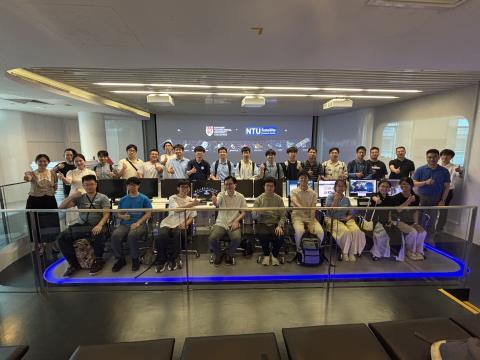
Today, that strength goes hand in hand with strict rigor, because our work has real-life consequences. Ensuring resilient PNT is not just an academic exercise. Our team built a GPS/BeiDou navigation performance monitoring system that is now in use at Shanghai Pudong International Airport. It watches over signal integrity for real flights. In civil aviation, you cannot treat extreme anomalies as just statistical footnotes. An event that happens once in a billion samples could be the one that matters most. This kind of work needs careful, long-term error modeling that accounts for seasons, environment, and time. It is something we must revisit and refine again and again. We are now starting to add data-driven methods into our traditional models, but the core of risk assessment must still rely on clear mathematical reasoning. For me, this balance between new ideas and careful thinking is the real magic of research. It is not about competing with others. It is about new questions pulling you forward into unknown territory, all with the aim of making navigation systems more dependable when conditions get tough.
I cannot say enough how much I owe to the mentors and communities that have carried me. Jade Morton has been much more than an advisor. She is like family. In moments of confusion and helplessness, she gave me not only scientific guidance but also deep human warmth. At my own university, the school and the GNC group have been a constant support. Professor Zhan's mentorship, always gentle but firm in reminding me to stay truly focused, has become a compass for my academic life. I also want to thank the many colleagues and friends who have walked this path with me. They have given me so much help along the way, and I hope they will forgive me for not listing all of their names here. My deepest wish is to follow in the footsteps of those who have guided me. I want to become a researcher who makes world-class contributions and to nurture a new generation of students who shine even brighter. This award feels like I have taken one small step toward that dream. But I know I still have a very long way to go. I have not done nearly enough.
Now, our team is taking these navigation frameworks into the field of Advanced Air Mobility. We want to help drones and eVTOL aircraft fly safely through the urban canyons we study. Again, it is about bringing resilient PNT to a new kind of challenging environment. I see the same flame of curiosity that was once lit in me now catching fire in my own students. They fill the lab with wild and wonderful ideas, and I try to give them the same trust and freedom I received. I tell them, "Being in aerospace is a true privilege. It is where national needs meet your deepest passion." Every small breakthrough, and every safe flight our work supports, brings a quiet joy. Guided by the light passed on to me, and grounded by the community that holds me up, I will keep working to make navigation more robust and more resilient, one step at a time.
Rong Yang
Shanghai Jiao Tong University