

IEEE/ION Position, Location, and Navigation Symposium (PLANS)
The IEEE and the ION welcomed 340 PLANS participants to Salt Lake City, Utah, for PLANS 2025. The ION and the IEEE AESS began the PLANS collaboration in 2008; PLANS 2025 being the 10th co-sponsored event for the two organizations. PLANS provides a technically productive exchange for the community; professional networking; the opportunity for academic publishing; and a model of a cooperative collaboration between societies.
Technical Program Reviewed
The PLANS event was chaired by Dr. Gary McGraw, ION president, with the technical program being organized by Dr. Christian Gentner from the German Aerospace Center (DLR). Dr. Gentner was assisted by Dr. Vibhor Bageshwar, Honeywell, chair of the Inertial Sensing and Technology track; Dr. Thomas Pany, Universität der Bundeswehr München; chair of the Integrated and Opportunistic Navigation track; Dr. Zak Kassas, The Ohio State University, chair of the Applications of Localization Technologies track; Dr. Mohammed Khider, Google, chair of the GNSS track; and Dr. Fabio Dovis, Politecnico di Torino, who organized the pre-conference tutorials program. The PLANS technical program hosted over 180 technical papers in the four technical tracks, and a full day of tutorials. “While the Inertial Sensing track had fewer papers than the others, it actually produced the best paper of the conference, winning the Walter Fried Award. This was a great example of quality over quantity. Many attendees specifically praised the quality of the content, finding the content high quality and engaging. The conference maintained a strong scientific focus, favoring in-depth research over surface-level talks, which made it especially valuable for those wanting to stay current,” said Program Chair Dr. Gentner. Attendees exhibited strong interest in LEO PNT, factor graphs, AI-driven navigation, and lunar and planetary navigation. New sessions on smartphone-based localization, quantum inertial sensors, AI navigation, and lunar navigation were especially well attended, and will likely to grow in future events.
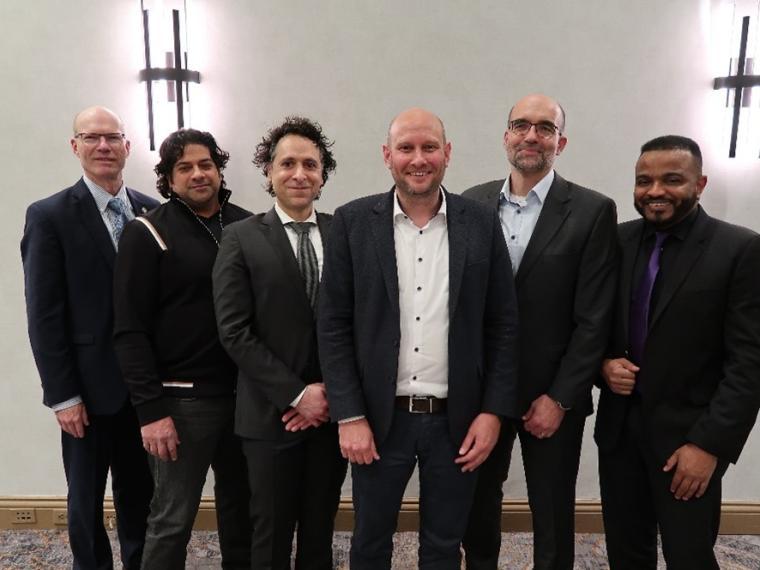
Dr. Gary McGraw, PLANS Executive Committee chair and ION president; Dr. Vibhor Bageshwar, track chair; Dr. Zak Kassas, track chair; Dr. Christian Gentner, program chair; Dr. Thomas Pany, track chair; and Dr. Mohammed Khider, track chair. Not pictured: Dr. Fabio Dovis, tutorials chair.
The invited sessions were among the highlights of the technical program. These sessions brought together focused contributions around specific themes and often delivered both technical depth and forward-looking insight. “Although the structure of invited sessions varied depending on the organizing session chairs, I appreciated the diversity of approaches. In some cases, the invited sessions included more exploratory or state-of-the-art talks, while others remained deeply technical and research-driven. In either case, they provided excellent snapshots of current work and challenges across multiple domains,” reported Dr. Gentner.
The highlight of the event was a keynote address by Dr. Bradford Parkinson, the “Father of GPS.” Holding the keynote the evening before the main conference, was a new idea this year, and it worked well. Dr. Parkinson gave a fantastic and inspiring talk that drew a great crowd and received positive feedback. Dr. Parkinson addressed positioning, navigation, and timing (PNT) as an essential element of national power; the need to assure PNT capability for humanity; and covered the evolution of GPS, from its early struggles to its indispensable role in today’s world.
Recognition of Technical Achievements
The IEEE’s Walter Fried Award, recognizing the best technical paper presented at the PLANS conference, was presented to Dr. Valerie Renaudin for the paper Anticipating Pedestrian Movements: Future Activity Prediction for Floor-Change Scenarios: Pavel Pascacio, Thomas Bonis, and Valerie Renaudin, Universite Gustave Eiffel.

2025 IEEE Walter Fried Award Winner, Dr. Valerie Renaudin, Universite Gustave Eiffel. The award includes a plaque and $750 honorarium.
The Walter Fried Award is endowed in memory of Dr. Fried’s professional engineering accomplishments, most notably by his technical leadership in the development of Doppler radar and relative navigation systems. During his distinguished career, Dr. Fried generously volunteered his time to the IEEE Aerospace Electronics Systems Society (AESS) by serving on the Board of Governors for many years and coordinating the activities of the AESS technical panels and the Distinguished Lecturers Program, of which he was also a participant. He was the AESS representative on the PLANS Executive Committee from the first conference in 1976 until his death at the age of 75 in 1998.
The IEEE AESS Richard B. Kershner Award, established to recognize individuals who have made a substantial contribution to the technology of navigation and position equipment, systems, or practices; was presented to Dr. Zak Kassas for his pioneering contributions to the theory and practice of positioning, navigation, and timing with terrestrial and non-terrestrial signals of opportunity.
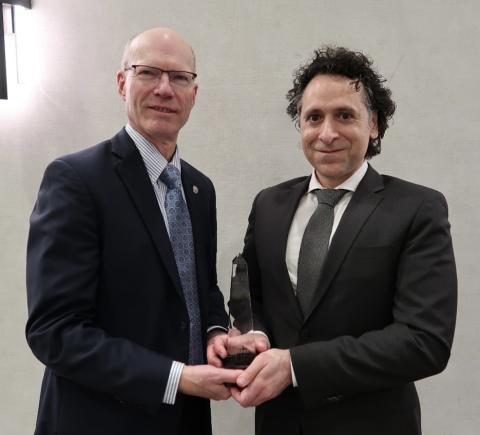
Dr. Gary McGraw, PLANS Executive Committee Chair and ION President, presenting the IEEE AESS 2025 Kershner Award to Dr. Zak Kassas, 2025 IEEE AESS Kershner recipient.
The Kershner Award was named for Dr. Richard Kershner who led the development of Transit, the world's first navigation satellite system. Dr. Kershner directed the development and launch of some of the world's first satellites, developed user equipment for both submarines and surface ships, and founded the science of satellite Doppler geodesy to improve knowledge of the Earth's gravity field. The result was a navigation satellite system, which served the U.S. Navy and tens of thousands of civil users worldwide. His technical contributions and his leadership of this program are examples of the highest standards of personal and professional performance the Kershner award emulates.
Additionally, PLANS recognized the best student paper and best paper from each track as follows:
BEST STUDENT PAPER AWARD (certificate and $400 to presenting author):
A Mock Implementation of Fused LEO GNSS: Samuel C. Morgan, Zacharias M. Komodromos, Wenkai Qin, Zachary L. Clements, The University of Texas at Austin; Andrew Graff, CesiumAstro; W. Jeremy Morrison, and Todd E. Humphreys, The University of Texas at Austin
BEST IN TRACK PAPER AWARDS (certificate and $250 to presenting author):
From the Inertial Sensing and Technology Track:
Warm Start Navigation with Non-Cooperative LEO Satellite via Online Ephemeris Error Estimation: Samer Hayek and Zaher M. Kassas
From the GNSS Track:
Residual GNSS Ionospheric Error Analysis in Future Low Earth Orbit Applications: Can Oezmaden, Sarah Pelzer, RWTH Aachen University; Omar Garcia Crespillo, German Aerospace Center (DLR); Marius Brachvogel, Michael Niestroj, RWTH Aachen University; Michael Meurer, RWTH Aachen University and DLR
From the Integrated and Opportunistic Navigation Track:
Light will Guide You: Passive Joint DOA/FOA Sensing, Tracking, and Navigation with Unknown LEO Satellites: Sharbel Kozhaya, Joe Saroufim, Samer Hayek, Paul El-Kouba, and Zaher M. Kassas
From the Applications of Localization Technologies Track:
GenAI for Energy-Efficient and Interference-Aware Compressed Sensing of GNSS Signals on a Google Edge TPU: Thorben Wegner, Lucas Heublein, Fraunhofer Institute for Integrated Circuits IIS; Tobias Feigl, Fraunhofer IIS and Friedrich-Alexander Universität; Felix Ott, Christopher Mutschler, Alexander Rügamer, Fraunhofer IIS
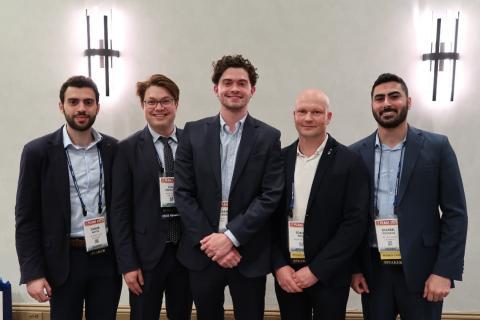
Best Paper Award Winners: Samer Hayek, Best in Track; Can Oezmaden, Best in Track, Samuel Morgan, Best Student Paper; Thorben Wegner, Best in Track; and Sharbel Kozhaya, Best in Track.
IEEE and ION have already begun to plan PLANS 2027, to be held in the spring of 2027. The PLANS 2027 technical program will be organized by Dr. Fabio Dovis, Politecnico di Torino, and additional information will be available at: https://www.ion.org/plans.