

Roberto Sabatini at AESS and the AIAA Students Branch in the UAE
Host: AESS and the AIAA Students Branch in the UAE
Event Date: 10 April 2025
Event Format: In-Person Presentation
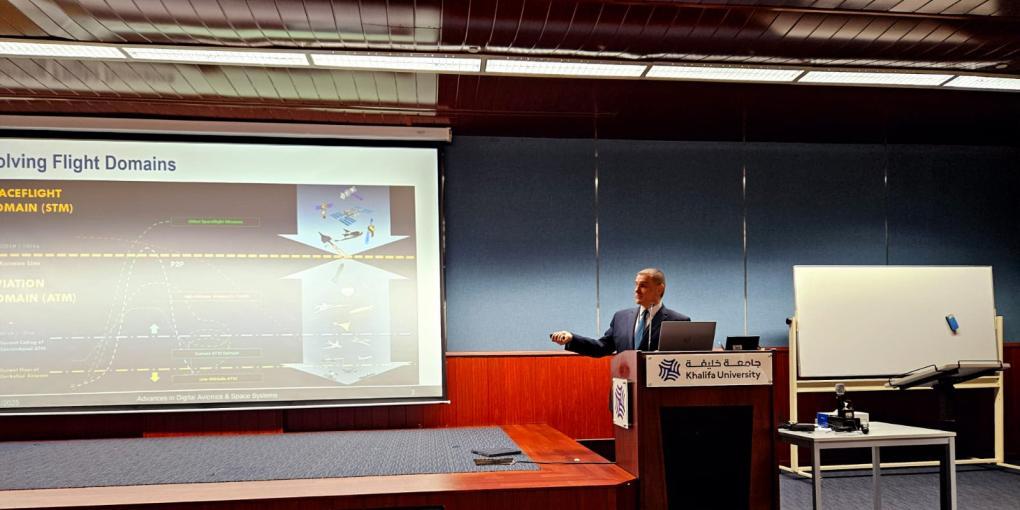
Event Summary: This Distinguished Lecture (DL) was co-hosted by the AESS and the AIAA Students Branch in the UAE. It focused on contemporary advancements in digital avionics and space systems. This DL highlighted the crucial roles of digital avionics, astrionics, and Air Traffic Management (ATM) systems in enabling the safe, efficient, and sustainable growth of the air and space transport industry. It aimed to disseminate recent technological and regulatory advancements while identifying opportunities for innovation within strategic areas, particularly future Decision Support Systems (DSS) for Intent-Based Operations (IBO) and Multi-Domain Traffic Management (MDTM).
The DL started with the SESAR/NextGen top-level requirements, concentrating on integrated Communication, Navigation, and Surveillance/ATM (CNS+A) systems. These systems implemented 4-Dimensional Trajectory Optimisation (4DTO) algorithms, data link communications, and enhanced surveillance technologies. It included the development of adaptive cognitive Human-Machine Interface (HMI2) systems, which allowed for the automated negotiation and validation of aircraft intents, thereby promoting safer and more efficient ATM operations. Specific requirements for Unmanned Aircraft Systems (UAS) navigation, communication, and cooperative/non-cooperative Sense-and-Avoid (SAA) technologies were also addressed, facilitating safe access for UAS across all airspace classes. Concurrently, advancements in spaceflight research led to introducing numerous reusable manned and unmanned space vehicle concepts, unlocking new opportunities for the burgeoning space transport sector. Ensuring that future space transport operations are technically and commercially viable required establishing acceptable safety levels. This necessitated developing novel digital tools, such as mission planning and decision support systems, leveraging advanced CNS+A technologies for seamless integration into the existing ATM network. While the technical maturity of propulsion and vehicle technologies was deemed relatively high, a review of emerging operational concepts highlighted challenges and opportunities tied to integrating cyber-physical and autonomous systems into point-to-point suborbital spaceflight and conventional air transport. The initiative emphasized various viable launch and re-entry methodologies, assessing their physical and computational limitations regarding future commercial space operations. Recent research shifted focus to the on-orbit phase, analyzing the unique hazards of the space environment and the necessary elements for space object de-confliction and collision avoidance modeling. Regulatory framework evolution supporting spacecraft operations emerged as a critical factor, requiring a holistic approach and substantial government support for successfully developing sustainable business models, including strategies for space debris mitigation, operational risk assessment, and liability concerns. Lastly, the initiative called for identifying extensions and alternatives to conventional airspace segregation and developing adequate modeling approaches to meet on-orbit risk criteria.