

Story Behind the Success: Radar Challenge Winners at the 2025 IEEE Radar Conference

I first heard about the AESS Radar Challenge while developing an adaptive beamforming tutorial at RadarConf 2024 with Jon Kraft, Dr. Mike Picciolo, and Dr. Marc Litchman. Jon mentioned the competition, and I attended the session out of curiosity. The format and the focus on practical radar problems really appealed to me. At the conference, I heard a talk by Dr. Chalise on Hybrid MVDR, and it immediately felt like the perfect follow on lab for our tutorial using the Phaser platform as well as a potential AESS Radar Challenge submission. I walked out of that talk wanting to try it right away.
Real life intervened. My PhD work and preparations for teaching a class on software defined radios the following semester took priority. While I was covering the topic of adaptive arrays in the class, I added a short slide about the AESS Radar Challenge to my course deck to make the students aware of it. After one of the lectures, a few students stayed behind to talk about ideas, and Rohit Rangaraj came up to ask if we could team up and submit a proposal.
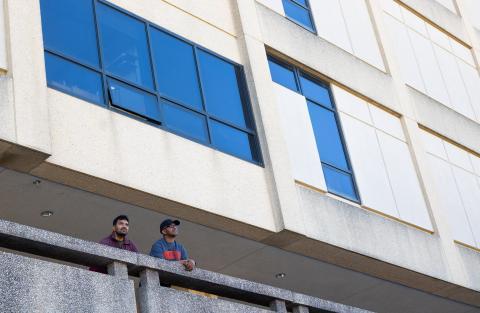
From left: Tarun Cousik M.S.'24 and Rohit Rangaraj. Photo by Niki Hazuda for Virginia Tech.
There was one small complication: the proposal deadline was the next day! By 5:00 p.m. on Friday we had sketched a rough plan. I wanted to demonstrate the original hybrid MVDR framework and then extend it to a hybrid LCMV design, while Rohit was excited about incorporating virtual array concepts. We had a quick call with Jon that evening, tossed a pile of ideas at him, and he patiently helped us filter what might work with the Phaser. We then rushed to write the proposal. We submitted the proposal on Saturday, slightly late, and although the committee noticed, they graciously agreed to consider it as long as the idea was truly sound and novel. We managed to squeezed through and suddenly had a real project on our hands.
During winter break Rohit and I worked through the original hybrid MVDR work in detail so that we would be ready to move to hardware in January. Around this time, Virginia Tech and Rampart Communications, had just received an NTIA NOFO2 award to work on interference excision for 6G systems, and I was fortunate to be included. We realized that the work for the challenge could easily help with the proposed efforts for the grant and support meant this challenge work could be integrated into my funded research, which made it much more sustainable. Dr. Nishith Tripathi, Dr. Jeffrey Reed, and Dr. Daniel Jakubisin, were instrumental in making that connection and supporting us as the project grew.
One turning point came during independent discussions with Dr. Jakubisin and Dr. Reed. As we individually walked them through the hybrid MVDR formulation, they pointed out a key discrepancy. The original work assumed access to a full dimension covariance matrix, which a hybrid array simply does not provide. In other words, the prior results described an upper bound on performance, and we had with no practical path to reach it. Overnight, our task expanded from implementing an existing algorithm on a board to developing an entire framework that could reconstruct or appropriately modify the full array covariance from hybrid measurements.
Intl. RadarConf 2025 was the next inflection point. I returned with an updated adaptive array tutorial with Jon, Mike, and Marc, and I used every hallway conversation and coffee break to probe this covariance completion problem with researchers I met, including Dr. Braham Himed and Dr. Bill Melvin. Dr. Melvin pointed me toward work on autoregressive processes where similar structures might have been exploited, and Dr. Himed mentioned that related ideas had appeared in earlier programs he had been involved with. That informal validation was my four-minute mile moment. It reassured us that we were not chasing an impossible idea.
During this time, Rohit was working in parallel to reproduce the original hybrid MVDR work and to understand the details of Manopt. He explored the different solvers, identified which ones were most stable, and developed ways to visualize manifold optimization in a more intuitive manner. His work gave us a strong foundation for the experiments that would follow.
Back at Virginia Tech we began exploring alternative approaches in earnest. We worked through seven or eight core ideas, each with many variations, before arriving at the general field of matrix completion as a promising direction. It felt surreal to realize that the problem we were wrestling with had been a central theme of the Netflix Challenge only a decade earlier, with mathematicians and researchers across the world trying to solve related issues in large scale matrix recovery. Throughout this exploration Jon and the Virginia Tech faculty were incredibly supportive, helping us avoid dead ends and preventing us from falling into sunk cost traps
Our initial plan seemed simple on paper. We would identify a matrix completion method that could recover the missing entries of the covariance matrix and then plug the result into the existing hybrid MVDR processing chain. In practice, this proved far more challenging. Many of the best performing matrix completion methods with publicly available code did not behave well on radar data, which forced us to dig into the underlying reasons. We began running controlled tests with simpler approaches such as SVD based thresholding to understand the structure of the problem more clearly.
During this period our conversations with faculty became crucial. Dr. Michael Buehrer encouraged us to examine the eigenvalue distributions in more detail, which led to several important insights about the structure of the problem. Soon after, Dr. Christopher Beattie noted that the SVD truncation and low rank completion approach we were testing was not appropriate for a covariance matrix. He recommended that we investigate eigenvalue thresholding instead. At the same time we were trying to preserve the entries we had directly measured while still enforcing positive semidefiniteness on the completed matrix. In other words, we wanted to keep all the trustworthy data and still obtain a mathematically valid covariance. These discussions helped redirect our efforts and clarified what a viable completion method would need to satisfy. That line of inquiry produced our first meaningful progress and showed us that we were on a workable path.
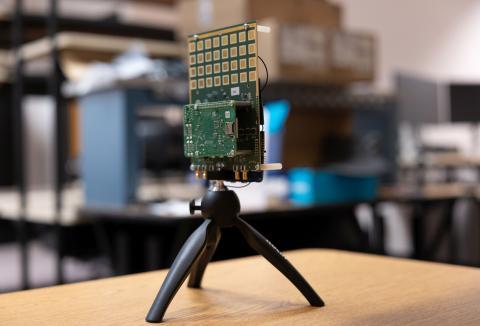
Test Device - ADI ADALM PHASER on a tripod. Photo by Niki Hazuda for Virginia Tech.
Around this same time I had an unrelated conversation with my colleagues Pratheek Upadhyaya and Anand Mahesh Kumar. Anand was describing an information-theoretic approach to UAV path planning and mentioned that he was implementing Dijkstra shortest path. I knew of the algorithm but was not familiar with the details, so I searched for it using my best guess at the spelling and accidentally ended up on the page for Dykstra Alternating Projections. For a moment I could not understand why a shortest path method involved alternating projections on convex sets until I noticed the disambiguation note and realized my mistake.
That mistake, however, ended up being the breakthrough. Dykstra’s algorithm gave us exactly the kind of alternating projection framework we needed to enforce positive semi definiteness while staying consistent with the measured entries. It felt like the missing piece we had been searching for. Fittingly, when this clicked, I happened to be listening to the song Rocky Road to Dublin from Sinners, so the name stuck, and we started referring to our overall framework by that title. By then we had about ten days left before the challenge submission, and everything accelerated into a blur of simulations, measurements on the hardware, and slide development. The extra two-week extension granted by the challenge committee turned out to be a lifesaver, giving us time to collect more data and polish the final presentation.
Throughout the process we made a deliberate effort to seek feedback from the broader community. In addition to the researchers already mentioned, we benefited greatly from discussions with Dr. Mike Picciolo, Dr. Brian Agee, Dr. Jeffrey Walling, Dr. Paul Petrus, Dr. Steven Ellingson, and many others who were generous with their time and insights. We also made use of a NVIDIA DGX machine provided by Cambridge Computers, which significantly accelerated our simulations and proved especially valuable during tight time periods.
Looking back, our success was shaped by the generosity of the many researchers who shared their time and insight with us and by our own willingness to stay nimble. We stood on the shoulders of giants at every stage and learned to be clinical in our decisions, ready to pivot whenever the data or the theory or sheer luck pointed in a new direction. That culture of openness, curiosity, and adaptability made the difference. It allowed us to navigate setbacks, incorporate new ideas without hesitation, and ultimately bring the project to a successful finish.
Written by Tarun Cousik, December 2025.
This research was partially supported by the U.S. Department of Commerce’s National Telecommunications and Information Administration (NTIA) under the Public Wireless Supply Chain Innovation Fund Grant Program (Award # 24-60-IF2415: ASPEN - Advanced Signal Processing Enhancement for Next-Generation Open Radio Units), administered by the National Institute of Standards and Technology.
We thank Rohde and Schwarz for donating the R&S SMW200A that was used to generate the signal of interest and interference signals
This work was developed on NVIDIA DGX platforms provided by Cambridge Computer.
Any opinions, findings, and conclusions or recommendations expressed in this publication are those of the author(s) and do not necessarily reflect the views of the U.S. Department of Commerce’s National Telecommunications and Information Administration (NTIA)