

Story Behind the Success: Ryan S. Park

Every engineer’s journey is shaped by mentors, challenges, and the relentless pursuit of knowledge. My own path has been no exception. From formative experiences during my school years to tackling the complexities of space exploration at NASA’s Jet Propulsion Laboratory (JPL), I have learned that success in this field is not achieved through grand leaps, but through steady, thoughtful progress. In this article, I invite you behind the scenes of my career, sharing pivotal moments, technical challenges, and lessons learned while navigating the ever-evolving landscape of space exploration.
My fascination with aerospace began during my undergraduate years at Penn State, where I had the privilege of learning orbital mechanics from Prof. Robert Melton. His passion for the subject and dedication to his students inspired me to pursue a career in aerospace engineering. After earning my B.S., I continued my studies at the University of Michigan, where I was fortunate to work with Dr. Daniel Scheeres, a renowned expert in astrodynamics whom I consider the best advisor a student could ask for. Under his mentorship, I delved into the complexities of spacecraft navigation, earning my M.S.E. and Ph.D. in aerospace engineering. My doctoral research focused on “Nonlinear Trajectory Navigation,” a field that blends mathematics, physics, and programming to solve the intricate problems of guiding spacecraft through the solar system. This rigorous academic training laid the groundwork for the challenges I would later face in my professional career.
After completing my Ph.D. in 2006, I joined JPL as a navigation engineer. Well-known for its role in exploring the solar system, JPL offered a humbling and exhilarating opportunity to contribute to its mission. My initial work involved navigating the Dawn spacecraft, a low-thrust mission to explore Vesta and Ceres. My job, as part of the Navigation Team, was to ensure that every engineering detail was meticulously accounted for while utilizing radiometric and optical navigation images to determine the current location and uncertainties of the spacecraft, and more important, predicting where the spacecraft was going to be and with what certainty in the future. When operating a spacecraft, the stakes are high–one miscalculation can mean the difference between mission success and failure. It was an eye-opening experience, markedly different from my previous research work. As a navigator, I spent a great deal of time addressing “what-ifs” that might never happen. This period taught me the importance of attention to detail: it is crucial to identify potential problems, be prepared for all kinds of possibilities, and have solutions ready in case they arise. Planning for the worst and hoping for the best is essential, as there may be constraints that prevent detailed studies when an actual problem occurs. It is also important to note that experience is key to bounding and sizing possible scenarios, which directly influence the overall cost and duration of such studies–that is, balancing resources to minimize risk.
As I gained experience, I became increasingly drawn to the unique challenges of determining the orbit and associated uncertainties of natural solar system bodies–planets, moons, asteroids, and comets. In 2011, I transitioned to JPL’s Solar System Dynamics (SSD) group, a team responsible for predicting the motion of all natural planetary bodies and recovering their physical characteristics. This work lies at the heart of space exploration, enabling missions to reach their targets with unprecedented precision. Since 2014, I have had the honor of leading the SSD group, which operates at the intersection of theory and application. Our primary task is to model the gravitational interactions between celestial bodies, accounting for the subtle influences of non-gravitational and even relativistic effects. These models are essential for trajectory design, mission planning, and precision navigation.
One of the most fascinating aspects of this work is the constant interplay between engineering and science. On one hand, we must develop robust algorithms and software to process vast amounts of data from spacecraft and ground-based observatories. On the other, we must remain attuned to the latest discoveries from space exploration, as new findings can dramatically alter our assumptions and models for maintaining the catalog of the orbits of all natural planetary bodies. Our team collaborates closely with scientists and engineers to refine dynamical models, ensuring our predictions remain as accurate as possible.
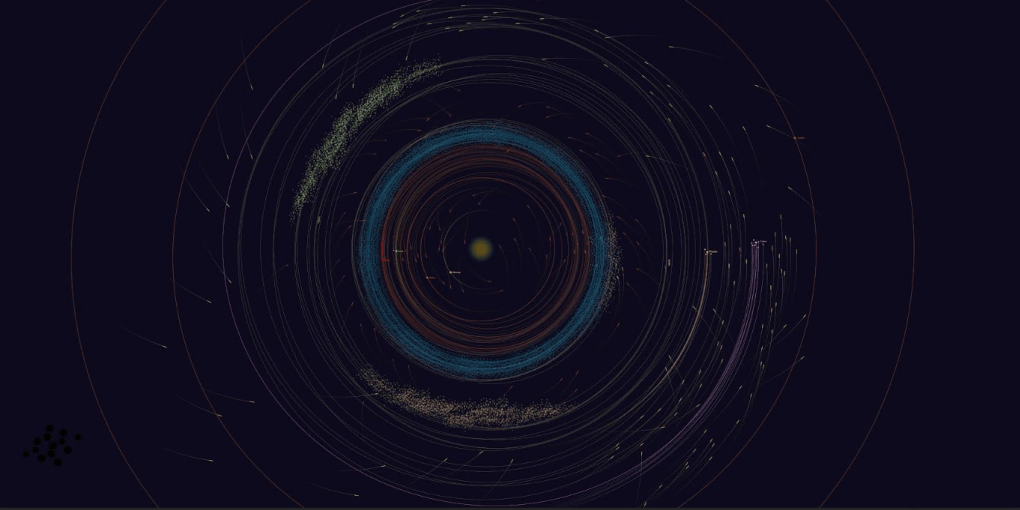
Working at the forefront of space exploration presents numerous technical and organizational challenges. The complexity of the systems we study means that uncertainty is ever-present. Variables are abundant, and even minor errors can propagate over time, resulting in significant deviations. One key lesson I’ve learned is the importance of adaptability. In deep-space navigation, there is rarely a single “right” answer. We rely instead on a process of successive approximation, refining models and adjusting strategies as new data become available. This mirrors the concept of a sequential filter–each new measurement reduces uncertainty and improves accuracy, allowing us to make the next informed decision. Another challenge lies in fostering effective communication and collaboration. Our team comprises experts in physics, mathematics, engineering, and programming, each bringing a unique perspective. Success depends on our ability to integrate these viewpoints into a coherent whole.
While technical expertise and careful planning are critical, I’ve also come to appreciate the role of readiness and serendipity in achieving success. Opportunities often arise unexpectedly, and being prepared to seize them can make all the difference. Maintaining a broad knowledge base and staying curious about developments in related fields have opened doors to new ideas and collaborations. It’s equally important to acknowledge the limits of our control. In engineering, as in life, certain factors remain unpredictable. The key is to focus on what we can control–preparation, diligence, and a commitment to continuous learning–while staying flexible amid uncertainty. Reflecting on my journey, several lessons stand out:
First, engineering is inherently iterative. Success rarely comes in a single leap; it is achieved through countless incremental improvements. Embracing this mindset helps mitigate the frustration that often accompanies complex projects. By developing a strong foundation of knowledge and experience, you can maintain momentum, effectively troubleshoot challenges, and continuously refine solutions to achieve the best possible outcomes.
Second, collaboration is essential. No one has all the answers, and the most innovative solutions often emerge at the intersection of disciplines. Strong communication skills and a willingness to learn from others are as vital as technical expertise. This also includes being empathetic toward others and considering mentoring whenever possible.
Third, resilience is critical. Failure is an inevitable part of engineering–but it is also one of its greatest teachers. The ability to learn from setbacks and persist in the face of adversity distinguishes successful engineers. Ultimately, what matters most is recognizing mistakes and using them as opportunities for growth.
Fourth, commit to your curiosity. The field of engineering is constantly evolving, with new technologies and discoveries emerging all the time. Staying curious and seeking out new knowledge ensures that you remain adaptable and innovative throughout your career. Lifelong learning is indispensable for an engineer.
Finally, focus on the process. While the challenges we face can be daunting, building strong systems and infrastructure, along with consistent and robust methods, enables us to accomplish extraordinary things. In other words, although the final outcome is important, the way it is created–the processes, standards, and validations involved–can be even more significant.
Looking ahead, the field of space exploration is poised for exciting advancements. Artificial intelligence, machine learning, and emerging sensor and computing technologies promise new capabilities for autonomous spacecraft and real-time decision-making. Meanwhile, ongoing space science discoveries continue to reshape our understanding of the solar system.
Space is becoming increasingly accessible. I am optimistic about the potential of interdisciplinary collaboration to drive innovation in this field. By uniting experts from diverse backgrounds, we can tackle problems once deemed insurmountable. The next generation of engineers will play a vital role in shaping the future of space exploration, and I’m confident they will rise to the challenge.
My journey in aerospace engineering has been shaped by inspiring mentors, complex challenges, and a steadfast pursuit of knowledge. Behind every successful mission lies a story of perseverance, collaboration, and adaptability. As engineers, we must continually refine our understanding and push the boundaries of possibility. Be humble, passionate, curious, and resilient. Learn from those who paved the way for you, and strive to leave a path for others to follow. In doing so, we not only advance the frontiers of science and technology, but also inspire future generations to reach for the stars.
Ryan S. Park
Senior Research Scientist, Principal Engineer, Group Supervisor
Jet Propulsion Laboratory, California Institute of Technology